
March 31st has come and gone, but the LGPS Pooling Symposium made one thing clear: for the LGPS, this is...
DG Event Write-up

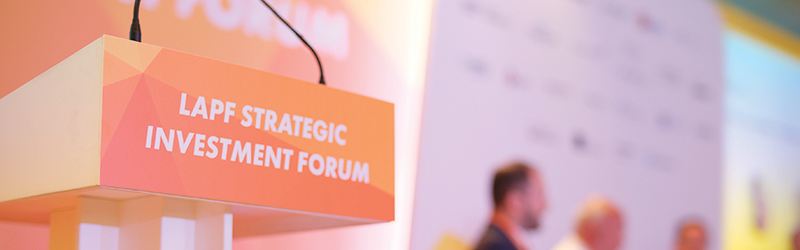
With the Pension Schemes Bill passed and pooling underway, LAPFSIF June turned to the harder tasks: surpluses, governance, inflation and housing that won’t stay still
Given everything that went down for the LGPS in the first quarter (and even creeping into the second quarter, thank you Mr Bell) of 2026, anything subsequently can feel a touch after the Lord Mayor’s Show – a chance to reflect, take stock of things and accelerate refreshed into what comes next.
And what better place to do that than in the relaxing, air-conditioned halls of The Grove Hotel. The third and final of our LGPS conferences in 2026, LAPFSIF June did feel like a fitting conclusion of what was a three-act drama.
While LAPFSIF February was littered with a little bit of last-minute angst with just a few weeks to go until 31st March deadline, and the Pooling Symposium saw attendees bask in the sense of relief that the Pension Schemes Bill had finally passed, LAPFSIF June was almost like the conclusion of the first part of a serialised novel – reflecting on what had come before, and getting ready for what comes next.
Not that everyone was pumped up and under starters orders for everything that is to come, with a level of reform fatigue felt by some.
Now of course this is totally understandable given how much has changed in the post Fit for the Future environment – but there are other areas where this burden is being felt, particularly on the not entirely unrelated topic of political interference.
More particularly still, this is being felt around surpluses, with one attendee explaining during a roundtable “there is a lot of political interference at so many levels… we’ve seen rates dropping as low as 0% in the LGPS recently, which is clearly not a sustainable thing to do in the long term.”
Given the funding pressures being seen at local councils, it is of course entirely understandable that there’s a substantial amount of pressure to reduce contribution rates – particularly given the “surpluses” being seen at funds across the sector.
Why put “surpluses” in quotation marks I hear you ask? Well because the truth is these surpluses – at least based on the views expressed in the room – only exist in theory rather than in practice.
As one table flagged while surpluses could potentially be real, it is only the case once you build in some form of buffer – with most landing on the 120% figure before being truly sure of a surplus.
Despite a decent chunk of funds sitting above this threshold, attendees cautioned there shouldn’t be knee-jerk responses when it comes to cutting contribution rates as they may then have to push them back up next time a valuation comes in.
These considerations have become ever more prevalent, particularly given the financial pressures being felt by employers. One attendee explained: “[It’s important to] recognise the pressures there are on employers – and not just local authorities, but charities and other members of the funds, and the pressures that exist there.”
It was also argued that there should be a buffer downwards for employers. One attendee explained: “We’re very quick to ask for our deficit contributions, and we are now going ‘I’m not going to give anything back because I need a buffer’ – so that should work both ways.”
Governance was unquestionably a key topic of conversation across the two days – unsurprising given the reforms that are ongoing for the industry, whether that is the appointment of an Independent Person or the arrival of the senior LGPS officer as a going concern in the sector.
All told, especially post the arrival of pooling, the generally held view was that governance had improved in recent times – mostly due to the consistency being brought to the industry.
Despite this, several draw backs were flagged, and a number of improvements, it was suggested, needed to be made. One contributor explained: “It’s more challenging to get things done.
“Things take a lot longer. There are more layers, so it can be more expensive and take more time to make decisions.”
Another contributor explained the need for improved reporting to standards that are simplified and harmonised, and done in a way that enables a public demonstration of good governance.
This can be achieved through more regulatory stability, therefore it is key that there are no new mandates or further prescriptive requirements – instead there needs to be space for the current governance model to bed in.
Others believed – given the reforms around pooling – governance can’t be judged as “settled” yet, with the entities that the governance framework sits on still moving.
All told, improvements have been made on the governance front – but it has to be judged against what is, at present, a backdrop that is itself still changing.
Economic worries were also a key topic of conversation during the conference – with one presenter flagging the nature of inflation had changed, arguing that high inflation is not a passing phase but a permanent feature of the system.
They explained: “I’m not saying inflation is a structural problem, I’m saying inflationary pressures are structural.”
There are several areas driving these pressures – particularly climate change. This is – among other things – having a devastating impact on food production with this particularly impacting crop yields, which in turn is having an impact on agricultural prices.
Additionally, a case has to be made for geopolitical fragmentation as a driver, with tensions in the Gulf forcing shipping to reroute to around South Africa – as such adding thousands of miles and a good deal of fuel cost to anything that moves by sea.
A shrinking global working-age population is also expected to cause an inflationary strain on the market, with labour costs as availability falls – a trend that is “structurally higher” regardless of what any one government does about wages.
As such, if central banks have finally accepted these pressures aren’t transitory, Gilt yields with a four in front of them may be here to stay. And, while this may be an uncomfortable position, it won’t be without its opportunities for those managing solvency and liquidity with a long lens.
If inflation gave delegates plenty to chew over, housing gave them something closer to a reckoning.
The scale of the problem was laid bare early: institutional capital makes up roughly 3% of the UK’s private rented sector.
This is compared to something closer to 30% in the US and 18% in Europe, leaving what one contributor termed the “missing middle” – households earning somewhere in the region of £30,000 to £70,000 combined – stuck between social housing they don’t qualify for and ownership they’ll likely never afford.
The most memorable moment of the session wasn’t a statistic, though. It was an anecdote.
Having overseen the deployment of institutional capital into a well-regarded single-family housing scheme in an affluent area, the presenter described driving home afterwards through inner-city streets that had seen none of that same investment asking themselves how that same positive impact was ever going to reach them.
In terms of driving growth, interestingly the barriers here aren’t financial. Yields are attractive, capital is available, and the market has shown it can innovate when it wants to.
The gap, instead, is one of structure and geography: capital knows how to find affluent suburbs and city centres, but hasn’t yet built the vehicles to reach the older, energy-inefficient fringe around them.
One proposed fix leaned on exactly that – a two-vehicle model offering “national diversification, but local outcomes,” letting funds back a broader pool while still directing a slice of capital toward a defined number of homes in a defined place.
Three acts in, the sector’s challenge is no longer reacting to change but learning to live with it – bedding down pooling and governance while inflation, employer pressures, and the housing gap keep moving in real time. Reform fatigue is understandable, but the work now is quieter: getting the structures right rather than rushing to fix them again.
The next chapter starts now.
|
|
|