With £400 billion in assets, the LGPS looks like a sovereign wealth fund in waiting. Barry McKay argues it should stay...
Report

|
Chris Roebuck |
Transformational leadership speaker Chris Roebuck, who spoke at LAPFSIF in February, draws on 40 years of leadership experience to argue that the UK pensions industry’s coming transformation will not be won or lost on strategy alone – but on the quality of the leaders driving it
The UK pensions industry is in the process of significant change and transformation. In this environment, the question facing senior pension fund leaders is no longer simply:
“How do we optimise returns?”
It has become:
“How do we achieve change while continuing to deliver those returns?”
Pension fund leaders have always needed strong technical expertise to deliver those returns, but the next phase of the industry demands more of leaders.
Leaders who can:
When faced with a demand for change most organisations focus on strategy, organisational structure, cost efficiency, operational and project management. But as the pace of change accelerates these alone are not enough to deliver success.
“80% of change initiatives fail” is a common phrase, but is inaccurate, the quote was “80% of change initiatives fail to deliver the ROI expected.” But no matter which it shows we have a significant problem with our ability to deliver successful change.
The success of any transformation ultimately depends on one factor: the effectiveness of the leaders driving it.
One of the things that has become abundantly clear in my 40 years of leadership experience in the military business and in government, as well as evidence from case studies, is that organisations across industries are not operating at their full potential.
Up to 80% of organisations are losing 10% – 20% performance everyday – millions in lost revenue and ROI.
If that is the situation in organisations in “business as usual” mode, then is it not surprising that when change is introduced cracks start to appear.
The core driver of lost performance is not poor strategy or insufficient resources but ineffective leadership. This is not about leaders not giving their best, but leaders who doing their best with the skills they have been given.
The reality is that about 80% of leaders have never been developed in some of the most critical leadership skills at any point in their career. This is a long-term failure of leadership development.
That failure is illustrated by the data from Gallup showing the average number of employees giving their best in organisations has gone up by just 5% since 2005, to only 30%. In UK it’s under 20%.
That’s despite billions being spent on leadership development over those 20 years.
Unless urgent action is taken to enhance leaders’ capability these 10-20% performance losses will continue day after day, and change will be ineffective.
Leaders know what they have to deliver, operational or strategic objectives, but don’t have a roadmap to deliver them optimally. They have the “what” but cannot optimise the “how”. Yes, they will get something done but with a 10% – 20% impact loss.
Fortunately, because leaders’ shortfalls are in fundamental leadership skills which are relatively simple to teach (eg effective delegation) they can be quickly made up through short, focused interventions.
You may think that you are delegating effectively every day. That leaders are delegating is not in dispute, the question is whether they are doing so optimally.
To address this challenge I have developed a strategy which would potentially solve these dual problems: put in place critical leadership capability and weave it into a roadmap that would ensure leaders focus on key actions every day that ensure organisational success.
To be successful, pension fund leaders need more than vision. They need a structured, practical roadmap to translate planned change into day-to-day implementation.
My Accelerate Your Success roadmap creates a set of areas of focus for leaders which are likely to ensure organisations not only take “business as usual” to excellence level but can then build the “business of the future”, which is what the pensions industry is seeking to achieve now.
Combine that with the missing skills to make it happen then you have a powerful combination of new capability and focused action.
Figure 1: Six steps – accelerate your success roadmap
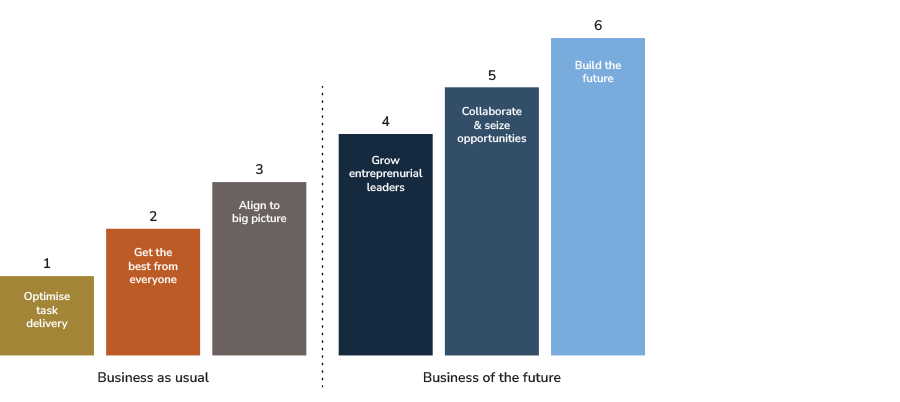
The six steps build on one another into a powerful multiplier of organisational performance.
Figure 1 shows the steps together with the potential performance uplifts they can deliver.
Optimise task delivery – creating extra bandwidth for leaders to focus on high return on investment activity whilst teams deliver outcomes more effectively. Execution is key during transformation as there is a risk that core processes become less effective. Leaders must ensure that task delivery remains focused, priorities are clear, and decision-making remains effective.
This can be easily achieved as there is significant opportunity to find leaders more time to focus on high ROI activity. When I speak to audiences around the world I run a short 5-minute exercise. Consistently this finds every leader in the room on average half a working day a week more time.
This confirms that whilst leaders may be delegating every day, most are not optimising delegation and we have significant hidden performance potential we just aren’t using.
Get the best from people – there are consistent simple day-to-day actions leaders can take which will significantly boost employee engagement, so everyone gives their best.
From my work with leaders here is a consistent list of about 12 day-to-day actions which any leader can use to get the best from everyone working for them.
Here are examples of those which deliver significant ROI in terms of extra effort:
Combined, these behaviours unlock a significant uplift:
Thirty percent more effort from 60% of people = ~10%+ overall performance gain.
Change creates uncertainty, and uncertainty reduces performance. Leaders who provide clarity, feedback, and support by using these types of actions can counter the impact of uncertainty.
That maintains and even potentially increases the extra effort people will give, effort which is key to success during periods of transformation and disruption.
Align to the big picture – alignment of operational activity to the delivery of strategic objectives through compelling vision and clear communication is essential. During transformation, individuals and teams can lose sight of strategic objectives.
Leaders must consistently reference the big picture and reinforce the change purpose, ensuring that decisions and actions remain connected to strategic outcomes.
Doing so not only ensures alignment but will boost employee effort;
With these three areas working effectively “business as usual” should be optimised. Then “building the business” of the future can start.
Growing entrepreneurial leaders – the development of a more entrepreneurial mindset, in particular amongst leaders, is critical for any organisation to be able to identify potential opportunities to be more successful. This recognises that successful transformation is a developing journey not a fixed project plan.
Seizing opportunity – once those opportunities have been identified, it is about having a clear process for the evaluation of opportunities and their return on investment to decide which ones to leverage.
Building the business of the future – the integration of new opportunities and excellent business as usual is what creates the business of the future.
Leadership is the bridge between plans, transformation and ROI. The roadmap shows the way. When applied effectively it delivers:
These outcomes translate directly into improved organisational performance of potentially 10%+.
But the roadmap also minimises the risks associated with transformation – delays, cost overruns, misalignment, and missed opportunities.
For pension fund leaders, the opportunity is there to take.
The organisations that succeed during the industry transformation will not be just those with the best strategies. They will be those with the most effective leadership.
Leadership is the difference between change which is “just good enough” and that which is “successful”. The latter delivers real ROI, the former doesn’t.
You wouldn’t travel anywhere new without a roadmap to show your route and guide you to your destination successfully. On a change and transformation journey the same applies! Good luck!
If you would like to get more of Chris insights check out his other articles: https://chrisroebuck.live/leadership-articles.
|
|
|