Confronting scale and governance in the LGPS
Scale – how to achieve it and how it may provide opportunities into new asset classes and strategies was the main topic of conversation at this roundtable and the extent to which it will respond to changing needs of clients, members and markets
With new employer contribution rates set to take effect in 2026 – leaving many LGPS funds cashflow negative – the pressure is on pension pools to prove they can deliver both efficiency and performance.
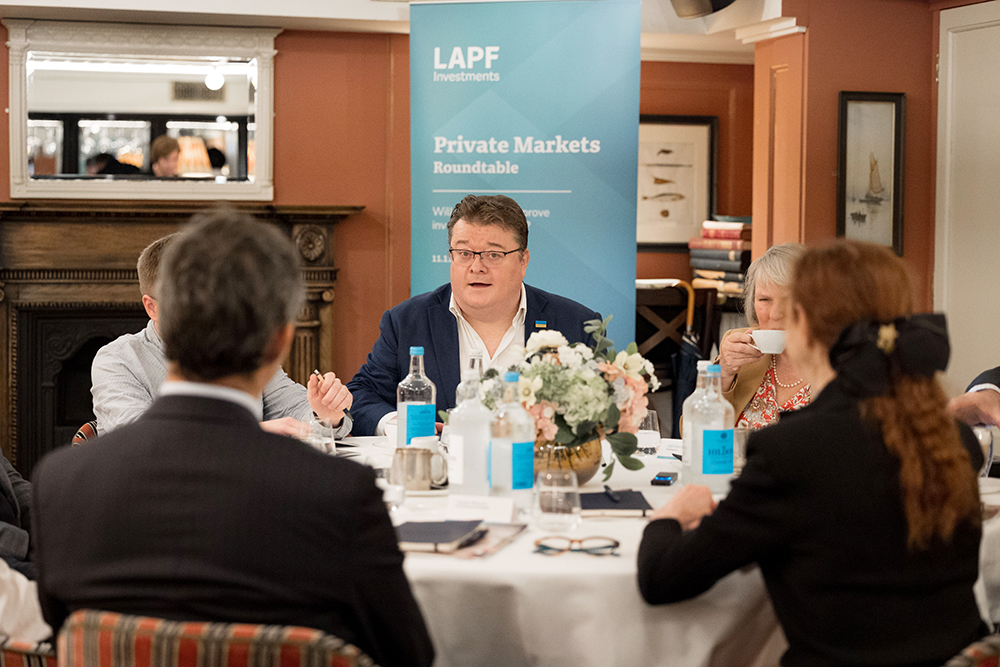
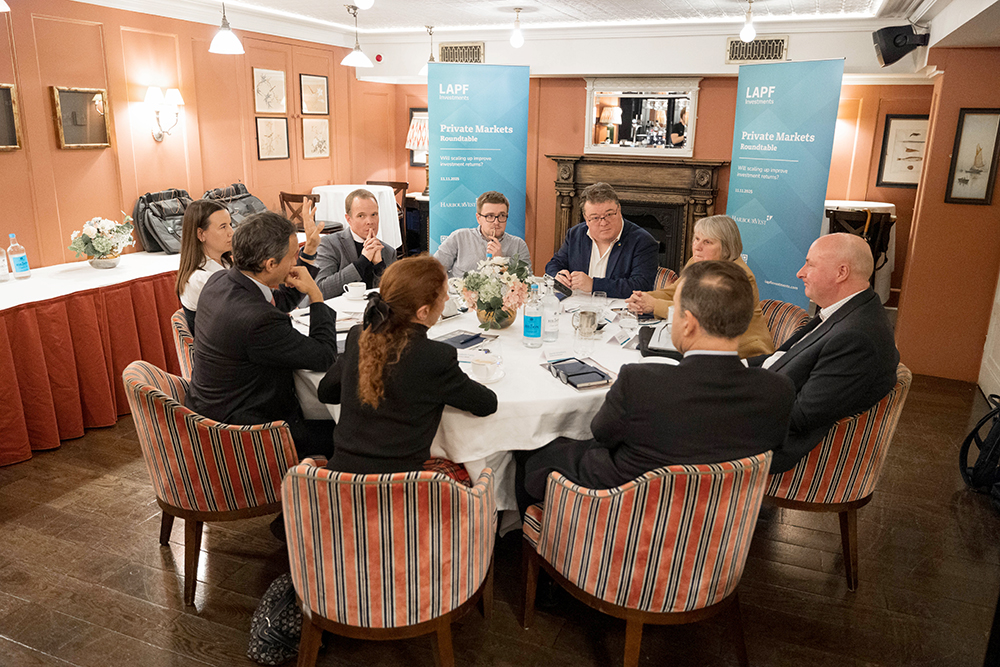
That was the backdrop to a round table convened by LAPF Investments magazine in association with HarbourVest in mid-November, bringing together senior figures from the Local Government Pension Scheme and leading consultants at Bentley’s Oyster Bar and Grill.
The central question: does scale actually deliver better outcomes? While larger structures can unlock advantages in infrastructure and private equity through discounted fees and co-investment opportunities, participants questioned whether the benefits hold across all asset classes. Governance concerns also surfaced, particularly around potential conflicts when pools both advise on and manage investments.
With single-digit returns from some illiquid assets and declining dependency ratios putting pension sustainability under scrutiny, the group explored where pooling has succeeded – and where it risks falling short.
The discussion began with what scale means to LGPS pools and funds and Jill Davys, head of LGPS at Redington said that while it is helpful in large scale infrastructure investment and private equity, it really depends on the underlying asset classes.
“There are benefits of being able to allocate reasonable sums of money, to get discounted fees and negotiate – particularly for direct and co-investments,” said Davys. It is quite different when allocating to smaller investments, like venture capital, which, she acknowledged the chancellor is keen on using to kick start the economy. “But it’s not realistic for pools to think they can do everything in a short space of time.”
Elizabeth Carey, independent investment adviser, said: “Size is actually quite a risk and we need to focus on returns,” pointing to the example of a fund like Ontario Teachers which allocates large amounts of its risk budget to private markets and real estate.
“They have not covered themselves in glory in terms of returns or meeting benchmarks,” said Carey.“I’m not sure that single-digit returns for illiquid assets are really very attractive. It’s not going to pay the pensions or reduce contributions or keep them sustainable over the longer term as we have a declining dependency ratio.”
Access, but not necessarily all areas
David Atterbury, managing director, investment team, secondary investments at HarbourVest, agreed with Davys about access being crucial in private markets to achieve efficiencies. The problem this causes is that it places investors into a larger, more competitive marketplace.
“The challenge is how to access large capital with a huge return dispersion in that asset class, but also lower mid-market,” said Atterbury. “There is always that conundrum of scale, access, and return and trying to get a grip across multiple markets is really tough with a single team.
The strategy you follow is more important than the size of the fund, said Jaime Alvarez, sustainable investment and private equity lead, Brunel Pension Partnership.
“Size allows you to have different strategies, but not all bigger strategies lead to better returns,” he said.
Smaller funds will find venture capital difficult, even with an external adviser, said Alvarez, and being small will always result in suboptimal outcomes. Pools simply cannot compete on costs, talent and won’t get the same access.
The trade off is going indirect and relying on larger managers who may be less aligned with your objectives, he said.
“All these things must be taken into consideration. If you focus on doing bigger things to reduce costs, you may end up with suboptimal outcomes.”
Building bridges
Phil Triggs, tri-borough director of treasury and pensions at Westminster City Council, said that funds no longer have any choice to look for external opportunities, but this is where the hard work begins.
“We really need to engage hard with the – in my case – London CIV. At the moment, there’s no private equity offering at scale and that should be the number one focus, while other things like cash management or a responsible investment strategy should be secondary,” said Triggs.
While there is a good investment case for climate change focused investments, social impact, etc, said Carey, it has to deliver an acceptable return. But funds must engage with their pools, particularly as they will be the chief source of advisory services. If funds do not engage, they will get “exactly what they deserve”.
Triggs says the notion of pools offering advice and leading the strategy is “a blatant conflict of interest and must be challanged, even if that is what the government would prefer. It will get in the way of providing investment solutions to funds’ strategies and focusing on the right managers.
“That’s all we need,” added Triggs. “Nothing more, nothing less.”
Alex Younger, head of funding and investment, Norfolk Pension Fund, said many funds remain somewhat uncomfortable about certain aspects of pooling.
“I fear there is a danger that some won’t look to other sources of advice,” said Younger, who also emphasised the need to negotiate terms of engagement for measuring performance.
“Certainly in the early stages of implementation, what are the triggers that may make us consider that we need to bring this back in before it goes awry?”
Transparency and accountability
Funds must be completely clear about their beliefs and objectives at the outset and communicate that to their pools, said Davys, and must be explicit on the level of risk they want in the portfolio, the level of return, how ESG is addressed, etc.
“Then if the pools fail to deliver it, they can be held to account,” she said.
“But it is essential that there are strong governance controls in place and also mechanisms for resolving conflict. But that comes back to governance at the end of the day.”
There is a natural tension emerging where the pools are starting to build their own capabilities in-house and offering advice to the underlying authorities as a kind of one-stop shop, said Emma Fox, vice president of the investor relations team at HarbourVest.
They now face a decision whether to do that themselves or make use of the third parties.
“They need the ability to be nimble and allocate in a way that takes best advantage of all that private markets has to offer, being able to identify those things early, gain access and then continue to allocate on an ongoing basis is pretty critical,” said Fox.
“I’ve proposed that partner funds – either individually or as a group for each pool – hire an adviser, whether it’s an investment consultant or even legal advisers, to work for them as a group,” said Carey. “I think it would be money really well spent.”
Beast of breed or DIY?
Chair Pádraig Floyd asked whether this might mean pools building something they may be better off leaving to someone better equipped externally – perhaps even another pool?
There was a feeling that there may not be much flexibility from the government to allow that, but Triggs said that other pooling opportunities will be possible, if another pool has a compelling opportunity.
“However,” he added, “the funds’ difficulty would be the multi layering of fees, which may make it difficult to justify.”
Whether pools choose to help themselves with external advisers, they also need to have a minimum of internal capabilities to be able to take care of the fiduciary responsibility of their clients, said Alvarez.
“This needs to be built up slowly to understand the different needs of partner funds and learn from working with others who have managed it internally in the interests of their clients.”
With new contribution rates coming in from April 1 2026, it is important to remember that there’s no new capital and that many more will be cashflow negative from that date.
“In reality, pools will have to make do with what they’ve already got, as new programmes will take a while to be built up and run in,” said Younger.
“I take some comfort from that, and for a fund that has stuck to its knitting and maintained its programmes, that’s probably not disastrous. Otherwise they may feel they are having to roll the dice, not quite knowing who they’re playing with.”
This is why it is essential that LGPS funds must advocate for their interests and not simply follow strategies because they suit the operations of the pool, said Carey.
“If you don’t have the operational facility, we need funds run by third party managers with the right level of liquidity. Funds and pools are going to have to become a bit more imaginative, with greater partnership. And they can’t do that all in-house.”
For this reason, funds and pools are more likely to work together to find ways to build internal capability while appointing managers to areas where there is a lack of skill or governance budget.
Making opportunities more attractive
Scale will definitely help give pools a seat at the negotiating table, said Fox. Additional scale makes that hybrid model more possible, for while pools could say they will go it alone, they can be very clear about how they would prefer to interact with the manager as a partner.
She questioned what LGPS can do to engage with the government to ensure there are sufficient numbers of investment opportunities that are investable.
“We have a partnership with the Canadian government that focuses on North American venture capital, particuarly Canadian VC, where the government has skin in the game alongside our limited partners (LPs).
“Those kinds of innovations have been very successful in making investments more attractive.”
Funds don’t have that that direct line into government, said Davys, as it all goes through just six pools.
“Sometimes their objectives may not be quite the same for a whole host of reasons, so it makes it difficult for funds to have those conversations.”
Even in Canada, the government has had to offer incentives to encourage capital in.
“I’m not convinced the UK government is very keen on putting skin in the game,” said Younger. “But if they were partially de-risk that, as an investor, it becomes incredibly attractive.
Building a sustainable future
Funds must build trusting, long-term relationships with the pools, said Younger, who hopes that his own pool is cautious in building out its proposition rather than going for a big bang.
He added: “But the ability to have more resource allocated should hopefully be realised in the returns.”
Alvarez said that pools must be clear on the partner finds and their members, but that larger size gives offers more strategic options, which is very positive.
“Along with diversification and avoiding jumping straight into direct investment, these are the main things I think that the pool should be remembering.”
“We need to remember liquidity and access to it in order to pay pensions, especially as funds become more cashflow negative,” said Carey.
Local investment that delivers returns and desired impacts necessitates a meaningful role for partner funds in pool governance. Local investment, pool governance and genuinely helping partner funds meet their fiduciary responsibilities are all very important. It is how these are all brought together that is crucial, she added.
There is a strong need for partnership across the board to drive an agenda and ensure some of the conflict challenges identified are overcome, said Atterbury. As well as partnership between the pools and the end managers, as well as, to ensure they deliver.
Fox echoed that sentiment when she said each pool will have to consider their partner funds, “collaborating closely, while maintaining a strategic, disciplined approach that focuses on the long term for private markets and identify how they can align themselves to the underlying authorities’ long term outlooks”.
“We’re at a pivotal point that centres around the 1st of April 2026,” said Triggs, as new employer contribution rates will limit cashflow and cause issues, while ongoing geopolitical events can impact any of the global markets.
“For practitioners, it’s all about having access to good investments, focusing on returns and blotting out the white noise that exists,” he said. “From that point onwards, it’s about engagement and influence with our fund partners and pools, and trying to gain access to these good investments.”
Ultimately, it is all about collaboration, said Davys: “There has to be give and take on both sides. But be clear on your objectives and be sure to put things in place that enable you to capture whether the pool has delivered.
“Finally, make sure there is proper oversight to make sure things don’t run away.”
Participants
Sponsors